
There are thousands of different cosmetic products on the market, all with differing combinations of ingredients. In the United States alone there are approximately 12,500 unique chemical ingredients approved for use in the manufacture of personal care products.
A typical product will contain anything from 15–50 ingredients. Considering the average woman uses between 9 and 15 personal care products per day, researchers have estimated that, when combined with the addition of perfumes, women place around 515 individual chemicals on their skin each day through cosmetic use.
But what exactly are we putting on our skin? What do those long names on the ingredient list mean and what do they do? While the formula of each product differs slightly, most cosmetics contain a combination of at least some of the following core ingredients: water, emulsifier, preservative, thickener, emollient, color, fragrance and pH stabilizers.
Water
If your product comes in a bottle, chances are the first ingredient on the list is going to be water. That’s right, good old H2O. Water forms the basis of almost every type of cosmetic product, including creams, lotions, makeup, deodorants, shampoos and conditioners. Water plays an important part in the process, often acting as a solvent to dissolve other ingredients and forming emulsions for consistency.
Water used in the formulation of cosmetics is not your everyday, regular tap water. It must be ‘ultra-pure’—that is, free from microbes, toxins and other pollutants. For this reason, your label may refer to it as distilled water, purified water or just aqua.
Emulsifiers
The term emulsifiers refers to any ingredient that helps to keep unlike substances (such as oil and water) from separating. Many cosmetic products are based on emulsions—small droplets of oil dispersed in water or small droplets of water dispersed in oil. Since oil and water don’t mix no matter how much you shake, blend or stir, emulsifiers are added to change the surface tension between the water and the oil, producing a homogeneous and well-mixed product with an even texture. Examples of emulsifiers used in cosmetics include polysorbates, laureth-4, and potassium cetyl sulfate.
Preservatives
Preservatives are important ingredients. They are added to cosmetics to extend their shelf life and prevent the growth of microorganisms such as bacteria and fungi, which can spoil the product and possibly harm the user. Since most microbes live in water, the preservatives used need to be water-soluble, and this helps to determine which ones are used. Preservatives used in cosmetics can be natural or synthetic (man-made), and perform differently depending on the formulation of the product. Some will require low levels of around 0.01%, while other will require levels as high as 5%.
Some of the more popular preservatives include parabens, benzyl alcohol, salicylic acid, formaldehyde and tetra sodium EDTA (ethylenediaminetetra-acetic acid).
Consumers who purchase ‘preservative-free’ products should be aware of their shorter shelf life and be conscious of any changes to the look, feel or odor of the product that may indicate it has gone off.
Thickeners
Thickening agents work to give products an appealing consistency. They can come from four different chemical families:
Lipid thickeners are usually solid at room temperature but can be liquefied and added to cosmetic emulsions. They work by imparting their natural thickness to the formula. Examples include cetyl alcohol, stearic acid and carnauba wax.
Naturally derived thickeners come, as the name suggests, from nature. They are polymers that absorb water, causing them to swell up and increase the viscosity of a product. Examples include hydroxyethyl cellulose, guar gum, xanthan gum and gelatin. Cosmetics with a consistency that is too thick can be diluted with solvents such as water or alcohol.
Mineral thickeners are also natural, and as with the naturally derived thickeners mentioned above, they absorb water and oils to increase viscosity, but give a different result to the final emulsion than the gums. Popular mineral thickeners include magnesium aluminium silicate, silica and bentonite.
The final group are the synthetic thickeners. They are often used in lotion and cream products. The most common synthetic thickener is carbomer, an acrylic acid polymer that is water-swellable and can be used to form clear gels. Other examples include cetyl palmitate, and ammonium acryloyldimethyltaurate.
Emollient
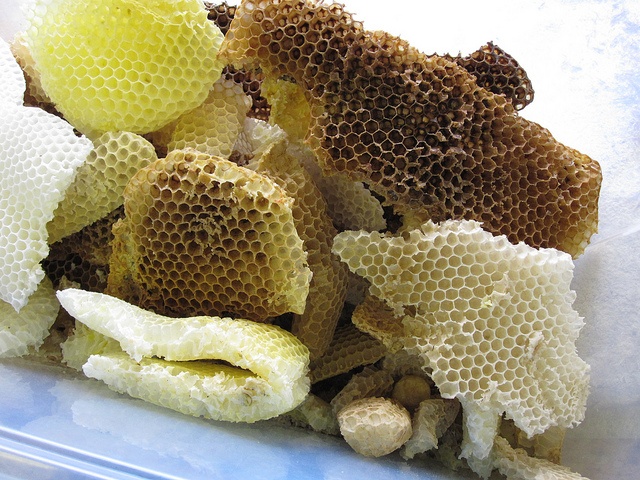
Emollients soften the skin by preventing water loss. They are used in a wide range of lipsticks, lotions and cosmetics. A number of different natural and synthetic chemicals work as emollients, including beeswax, olive oil, coconut oil and lanolin, as well as petrolatum (petroleum jelly), mineral oil, glycerin, zinc oxide, butyl stearate and diglycol laurate.
Glimmer and shine
Shimmering effects can be created via a range of materials. Some of the most common ones are mica and bismuth oxychloride.
Cosmetic mica typically comes from muscovite (KAl2(AlSi3O10)(F,OH)2) also known as white mica. It naturally forms in flaky sheets and these are crushed up into fine powders. The tiny particles in the powders refract (bend) light, which creates the shimmering effect common in many cosmetics. Mica coated with titanium dioxide gives a whitish appearance when looked at straight on, but then produces a range of iridescent colors when viewed from an angle.
Bismuth oxychloride (BiClO) is used to create a silver grey pearly effect. This compound occurs naturally in the rare mineral bismoclite, but is usually produced synthetically and so is also known as synthetic pearl.
The size of the particles used to create pearly and shimmering looks affect the degree of glimmer the product has. The smaller the particle size (15–60 microns, where one micron is one millionth of a meter), the less lustrous the powder will be, and more coverage it gives. Larger particle sizes, up to 500 microns, give a glitterier luster and are more transparent.
Fragrances
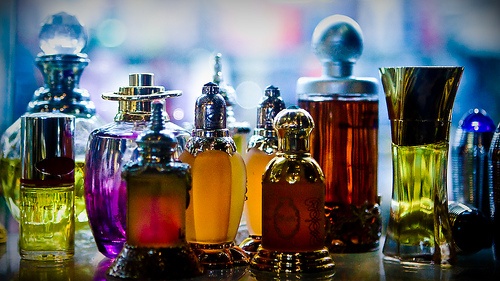
No matter how effective a cosmetic may be, no one will want to use it if it smells unpleasant. Consumer research indicates that smell is one of the key factors in a consumer’s decision to purchase and/or use a product.
Chemicals, both natural and synthetic, are added to cosmetics to provide an appealing fragrance. Even ‘unscented’ products may contain masking fragrances to mask the smell of other chemicals.
The term ‘fragrance’ is often a generic term used by manufacturers. A single listing of fragrance on your product’s ingredient list could represent dozens or even hundreds of unlisted chemical compounds which were used to create the final individual fragrance.
Manufacturers do not have to list these individual ingredients as fragrance is considered to be a trade secret.
There are over 3,000 chemicals used to formulate the huge range of fragrances used in consumer products worldwide. A comprehensive list has been published by the fragrance industry. All the ingredients on this list have passed the International Fragrance Association (IFRA) safety standards for use in commercial products. However, without knowing which individual ingredients went in to making up the fragrance of a product, consumers can find it difficult to make informed choices. If consumers are concerned they should look for fragrance free products and buy from companies that label their products more comprehensively.
Coloring agents/pigments
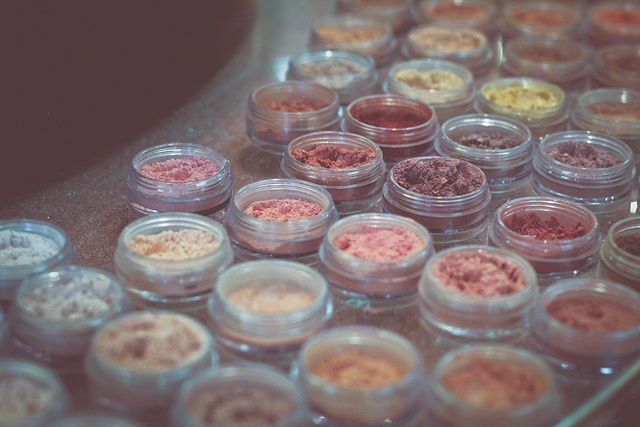
Ruby lips, smoky eyes and rosy cheeks; it is the purpose of many cosmetics to accentuate or alter a person’s natural coloring. A huge range of substances are used to provide the rainbow of appealing colors you find in the makeup stand. Mineral ingredients can include iron oxide, mica flakes, manganese, chromium oxide and coal tar. Natural colors can come from plants, such as beet powder, or from animals, like the cochineal insect. The latter is often used in red lipsticks and referred to on your ingredient list as carmine, cochineal extract or natural red 4.
Pigments can be split into two main categories: organic, which are carbon-based molecules (i.e. organic in the chemistry context, not to be confused with the use of the word to promote ‘natural’ or ‘non-synthetic’ or ‘chemical-free’ products) and inorganic which are generally metal oxides (metal + oxygen and often some other elements too). Inorganic should not be confused with ‘synthetic’ or ‘unnatural’ as most of the inorganic metal oxide pigments do occur naturally as mineral compounds.
The two most common organic pigments are lakes and toners. The lake pigments are made by combining a dye color with an insoluble substance like alumina hydrate. This causes the dye to become insoluble in water, making it suitable for cosmetics where water-resistant or waterproof properties are desired.
A toner pigment is an organic pigment that has not been combined with any other substance.
The inorganic metal oxide pigments are usually duller than the organic pigments, but are more resistant to heat and light, providing a longer-lasting color.
 Fashion Crisco